
Blog
How to Clean an Electric Kettle

Quick answer
Unplug the kettle and let it cool. Fill it halfway with equal parts white vinegar and water, boil it, and let it sit for 20 minutes. Pour it out, rinse well, and boil fresh water twice before you drink from it again.
Why you should clean your electric kettle
An electric kettle works hard every day, and most of us never look inside it. Over time, the minerals in your water settle on the metal and leave a white or grey crust. This is called limescale.
Limescale is not dangerous in small amounts, but it causes real problems. It slows down boiling, wastes electricity, and can leave flakes and a strange taste in your tea. A thick layer can even shorten the life of the heating element.
Better taste
Clean water means a cleaner cup of tea or coffee.
Faster boiling
A clean base heats the water quickly.
Longer life
Less scale puts less strain on the heating element.
Know your kettle parts
Before you start, take a quick look at these parts. You will clean each one a little differently.
- Lid
- Covers the top. Wipe it, but never soak the hinge.
- Spout filter
- A small mesh that catches scale flakes. It clogs easily.
- Inner body
- The steel or glass chamber that holds the water.
- Heating element
- The flat plate at the bottom. Scale builds up here first.
- Water level window
- Shows how much water is inside.
- Power base
- The electric stand. Keep it away from water.
- Handle and switch
- Wipe these with a damp cloth only.
How to clean an electric kettle: 8 easy steps
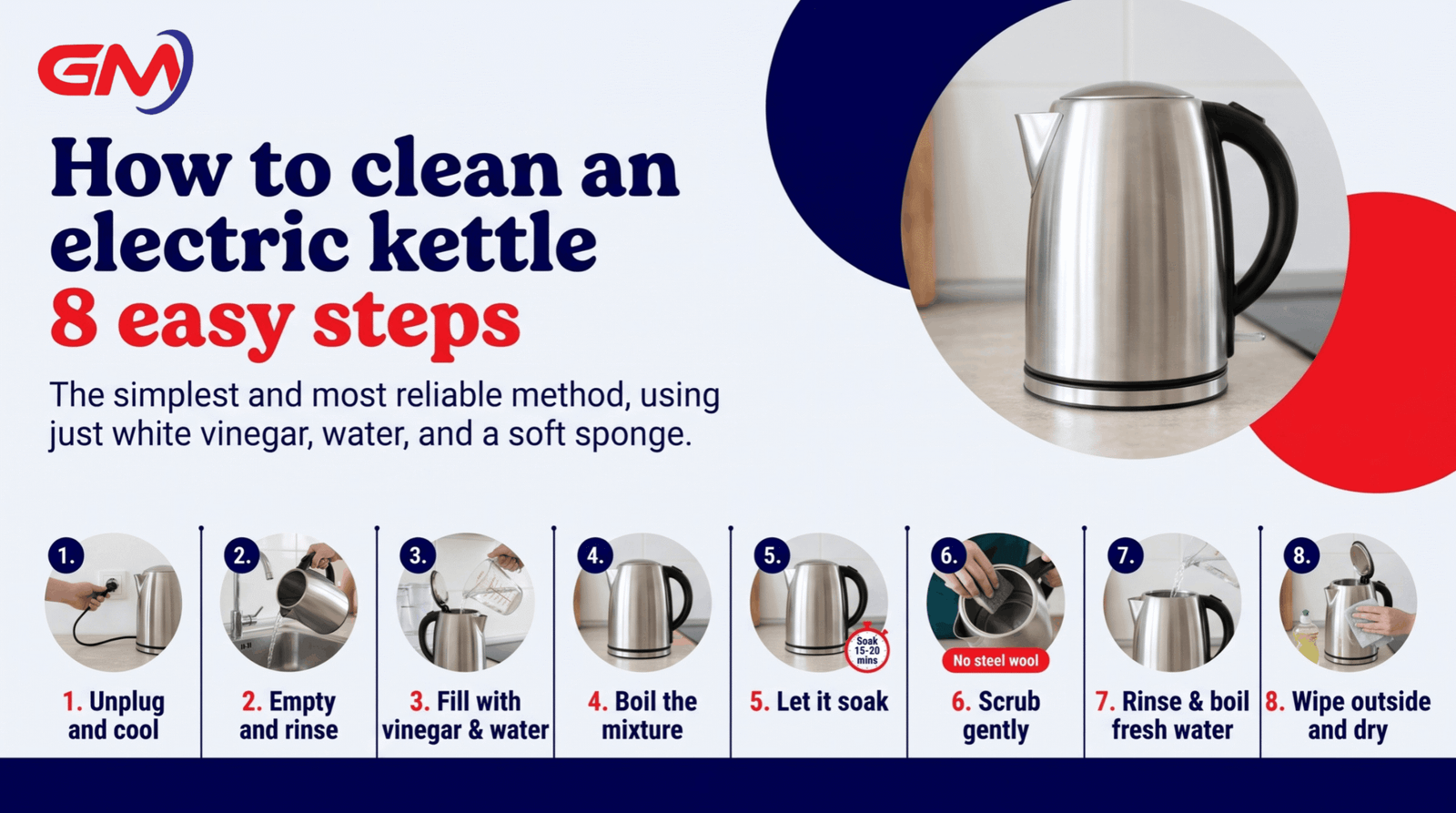
This is the simplest and most reliable method. All you need is white vinegar, water, and a soft sponge.
Unplug and let it cool
Take the kettle off its base and make sure it is not hot. Never clean an appliance while it is plugged in.
Empty and rinse
Pour out any leftover water. Give the inside a quick rinse to wash away loose flakes.
Fill with vinegar and water
Pour in equal parts white vinegar and clean water until the kettle is about half full. Do not go above the maximum line.
Boil the mixture
Place the kettle on its base and switch it on. Let it boil once, then switch it off. Open a window if the smell bothers you.
Let it soak
Leave the hot mixture inside for 15 to 20 minutes. Thick scale may need up to an hour. You will see the white crust start to lift.
Pour out and scrub gently
Empty the kettle and wipe the inside with a soft sponge or brush. Remove the spout filter and clean it too.
- Use an old soft toothbrush for the spout and corners.
- Do not use steel wool. It scratches the surface.
Rinse and boil fresh water
Rinse the kettle well. Then fill it with clean water, boil it, and throw that water away. Do this twice to remove the vinegar smell completely.
Wipe the outside and dry
Use a damp cloth with a drop of mild dish soap on the outside, the lid, and the handle. Wipe the power base with a dry cloth only. Leave the lid open so the inside dries fully.
Tip: Never pour water over the power base or dip the kettle in water. Only the inside of the kettle should touch water.
Other ways to descale your kettle
No vinegar at home? These options work just as well.
Lemon or citric acid
Boil water with the juice of one lemon, or two tablespoons of citric acid. Let it sit for 20 minutes, then rinse. It also leaves a fresh smell.
Baking soda
Boil water with one or two tablespoons of baking soda. It helps with stains and odours. Rinse and boil fresh water once.
Tip: Do not mix vinegar and baking soda in the kettle. They fizz and cancel each other out, so neither one cleans properly. Use one method at a time.
Dos and don’ts
Do
- Empty the kettle after each use.
- Use filtered water if your water is hard.
- Clean the spout filter regularly.
- Check your manual before using any cleaner.
Don’t
- Dip the kettle or its base in water.
- Use steel wool, bleach, or harsh chemicals.
- Leave old water sitting for days.
- Switch it on empty.
- Clean it while it is hot or plugged in.
How often should you clean it?
For most homes, a deep clean once a month is enough. If your water is hard or you use the kettle several times a day, clean it every two to three weeks. As a quick habit, empty it after use and wipe the outside whenever it looks dusty.
If your kettle has worn out, a loose lid, or a damaged part, you do not always need a new one. Browse GM Group spare parts to find the right match.
Frequently asked questions
Can you heat milk in an electric kettle?
It is possible, but we do not recommend it. Milk sticks to the heating element, burns easily, and can foam over the top. It is also very hard to clean, and leftover milk can start to smell. Most kettle makers also say to use it for water only. Heat milk in a saucepan or a milk frother instead.
How often should I clean my electric kettle?
Clean it once a month in normal use. If you have hard water, clean it every two to three weeks to stop heavy scale from building up.
Is it safe to use vinegar to clean an electric kettle?
Yes. White vinegar is safe for most stainless steel and glass kettles. Always rinse well and boil fresh water twice afterwards. If your kettle has a special coating, check the manual first.
What are the white flakes inside my kettle? Are they harmful?
They are limescale, which forms from the minerals in your water. A few flakes are not harmful, but they spoil the taste and make the kettle less efficient. A vinegar or lemon soak removes them.
Why does my kettle still smell after cleaning?
You may not have rinsed out all the vinegar or cleaner. Boil fresh water two or three times and throw it away each time. A new kettle can also smell of plastic for the first few uses, and this fades on its own.
Final words
Cleaning an electric kettle takes less than half an hour, and most of that is waiting. Descale it once a month, rinse it well, and keep the power base dry. Do this and your kettle will boil faster, your tea will taste better, and the appliance will last longer.